Some Thoughts on AI Consciousness

Matt Genovese
Founder, Planorama Design
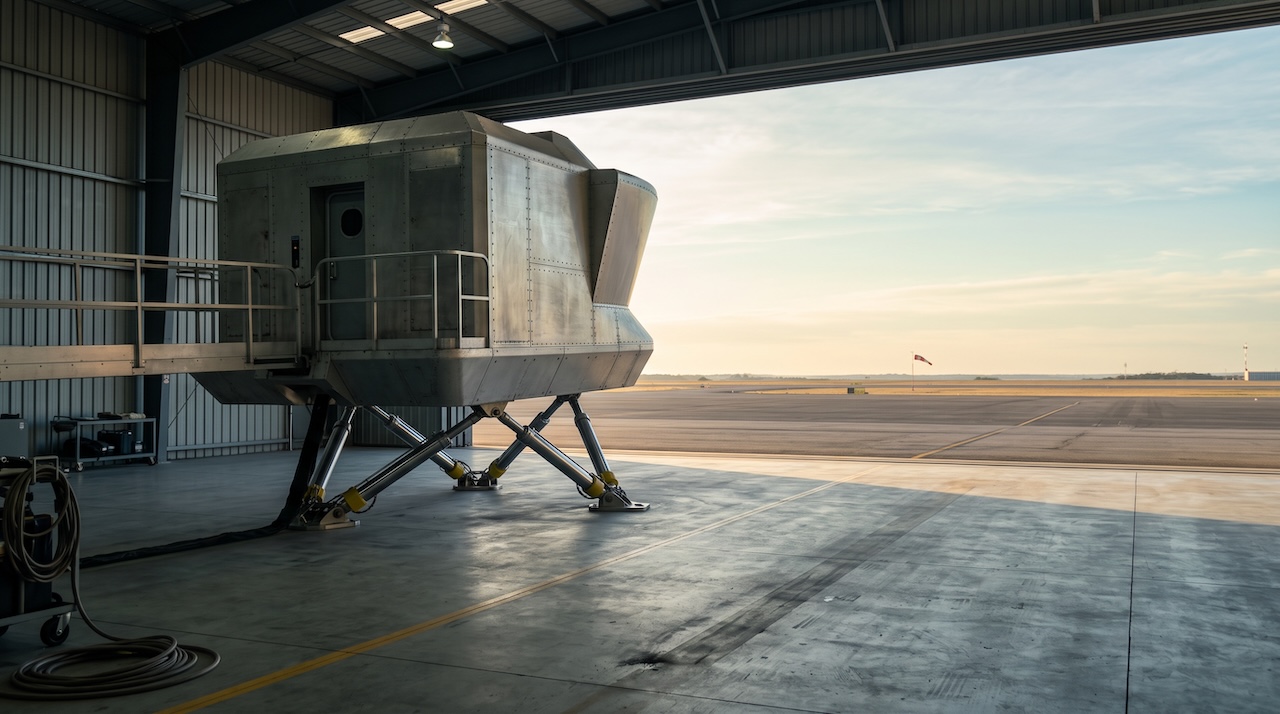
Flight simulators chase airplanes, and we are the ones who decided which of the two is the real thing. Push that far enough and machine consciousness starts to look less like a metaphysics problem and more like a vocabulary problem.
A friend asked me recently whether I think AI will ever be conscious in the way that a human or a dog is. It's a good question, and I found myself wanting to answer a different one first: what actually separates the simulation of consciousness from the thing itself?
Think about flight simulators. We have simulators, and we have airplanes, and the entire relationship between the two is one we designed. The airplane is the real thing, sitting more or less still as a target, and the simulator is the thing that chases it, closing the gap with every generation of hardware and software. The simulator experience advances; the airplane mostly waits. We built that asymmetry in ourselves, the moment we named one thing the original and the other the approximation, and it tells you nothing about the nature of flight.
So the interesting question becomes: at what point is the simulator equal to the airplane? And right away you run into the fact that nobody has bothered to say what "equal" means here. Does the simulator put you in the destination city? Obviously not, though you can imagine some future version that does, at which point we'd probably stop calling it a simulator and start calling it transit. More interestingly (and more darkly), can the simulator harm you when you crash it? Because if consequence is part of what makes the real thing real, then that's the parameter worth arguing about, not resolution or frame rate.
Now push it all the way. Suppose the simulator does everything the airplane does, including everything on your list of the properties that actually matter. Is it real? Is it merely equivalent to an airplane, or has it become identical to one?
I question that if we ever arrive at that point, we don't have a metaphysics problem, we have a labeling problem. We called one thing a simulator and the other an airplane, and the only thing standing between them is vocabulary we inherited from a period when the distinction was obvious and didn't need defending. We could just as easily say the simulator is a type of airplane, and that the thing with wings and jet fuel is another type of airplane, and the sentence would survive contact with reality just fine.
That, I think, is the same question we're actually asking. The argument worth having is about which properties we decided actually count, and whether we settled on that list before or after we knew what we'd be looking at. I don't have an answer, and I'm suspicious of anyone who says they do. What I've noticed is that most of the disagreement in this space is people arguing about airplanes while holding very different lists in their heads.
Matt leads Planorama Design, a product acceleration firm for enterprise software teams. With nearly 30 years of engineering experience, he helps CTOs and VPs of Engineering structure requirements, validate AI feasibility, and ship better software faster.
Most AI interfaces deliver output without helping users evaluate it. Designing for critical engagement belongs in the requirements phase, not the retrospective.
“Keep a human in the loop” has become enterprise AI’s default safety answer. Without a real design behind it, that answer may be making oversight worse, not better.